AI
Game AI
Overview
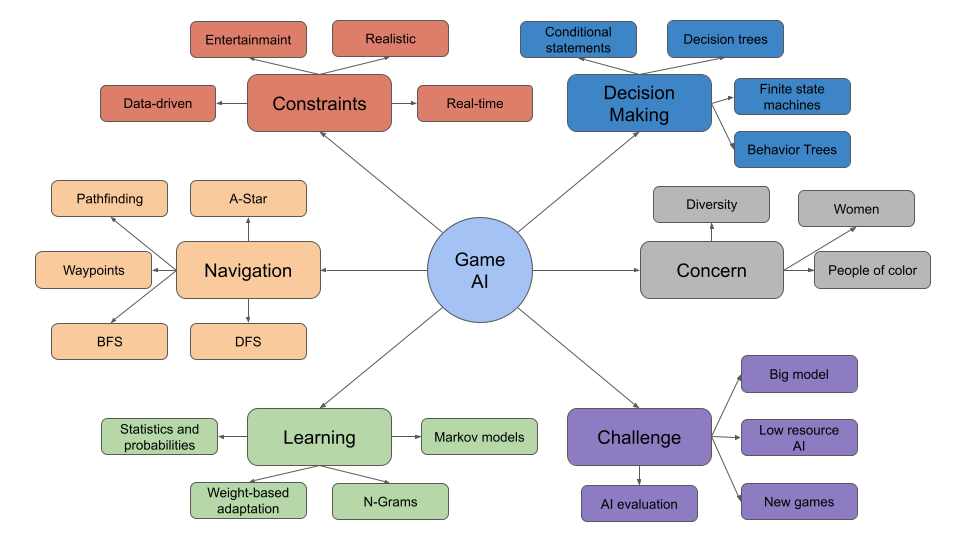
Game AI is one of the first AI applications in people’s life. It controls intelligent agents to take action by sensing the environment and making decisions. The agent could be a vehicle, a robot, or occasionally something more abstract such as a whole group of entities or even a country or civilization. Different from the real-world AI problem, such as self-driving cars, whose environment is pretty noisy and hard to understand semantically, games’ environment is designed and structured, and hence the AI can easily extract information from the environment. Therefore, making decisions and taking actions are the focus of game AI. Game AI also has particular constraints: (1) It is usually not pre-trained. (2) The game is usually supposed to provide entertainment and challenge rather than be “optimal.” (3) There is often a requirement for agents to appear “realistic.” (4) It needs to run in “real-time.” (5) It’s ideal if at least some of the system is data-driven rather than hard-coded. With that in mind, we can look at some simple AI approaches to decisions and actions.
Decision Making
The basic decision-making can be implemented by a hardcoded conditional statement or a decision tree. Early video games in the 1970s, such as Pong, mainly used this method. Although simple reactive systems are very powerful, there are many situations where they are not enough. For example, sometimes there are just too many conditions to effectively represent them in a decision tree and sometimes we need to think ahead and estimate how the situation will evolve before deciding our next move. For these problems, we need more complex solutions such as finite state machines and behavior trees.
Pathfinding
Pathfinding is almost involved in every modern game. In a soccer game, the AI player needs to find a path to block your football and in a first-person shooter game, the AI terrorist need to find a path to plant the bomb. The simplest way of finding a path is to use breadth-first search (BFS), depth-first search (DFS), or A-start search on a meshed map. However, movement by mesh is not realistic. To address this issue, we can use the “waypoints” system, as each node represents a significant position in the world that can form part of any number of hypothetical paths.
Challenges
We have witnessed the big progress of game AI in recent years. AlphaGo beat the two best Go players in the world in 2016 and 2017. But there are still many challenges around the game AI. First is the demanding requirements of ML-based AI. Training professional-level AIs for complex environments usually requires large computational resources. This may hinder game innovation and favor the monopoly of bigger players in the market. Second is the lack of standard AI evaluation. Current games usually utilize winning rates (against professional human players) based on evaluation criteria. However, such evaluation is relatively rough and against the objective of games: being fun and bringing happiness. The third is the new different types of games. Most games nowadays are symmetric. However, the real world is full of asymmetric games. So a practical issue raises, it may be a good direction to design asymmetric games, so as to develop decision-making intelligence for real-world problems.
Concerns
The field of game AI is currently dominated by the male and the white. That means we miss some important perspectives of what games should be from women and people of color. It may be reflected in the game characters which only show the taste of a specific group of people. It may be reflected in the game design which neglects the requirement of the under presented. Diversity isn’t just about avoiding mistakes or harm. it’s about fresh ideas, different ways of thinking, and hearing new voices.
Concept Map